The Relevance of the Bhagavadgita to Humanity 13-2: Swami Krishnananda.
 =====================================================================================================
Saturday 04, April 2026, 18:30.
Books: Bhagavad Gita
The Relevance of the Bhagavadgita to Humanity 13-2: Swami Krishnananda.
An Exposition of the First Six Chapters of the Bhagavadgita
Discourse 13: The Supremely Friendly Power:2.
Swami Krishnananda.
======================================================================================================

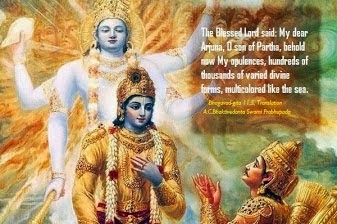
This very image of Nara-Narayana or Krishna-Arjuna as friends is given to us in another form in a passage of the Veda, and also in a passage which is repeated in the Mundaka Upanishad, that there are two birds perching on the branch of a tree. One bird is very busy with the delicious fruits of the tree, and the other bird is minding not as to what is there at all, not eating, not concerning itself with anything. The unfortunate part of it is that this busy bird eating the sweet plums is not even aware that the other bird is there nearby.

The involvement of the human mind, the engagement in human passions, desires and prejudices in the atmosphere of the world, is so intense that it cannot even be conscious for a moment that there is some super-earthly, super-physical, super-material, super-individual power masquerading in this very world unseen, unrecognised, and yet being aware of all things and ready to be of succour even to the littlest of creations. The idea behind the image of the friendship of Krishna and Arjuna perpetually obtaining, of Nara-Narayana or the two birds mentioned, is that we are not so very friendless as we may imagine in the desperate delusions of our minds, in the sorrows in which we are usually sunk. We do not find ourselves in that awakened atmosphere of it being possible for us to be conscious of there being such a thing. Like an owl which cannot visualise the light of the sun even if it is blazing at midday, the sunk mind of the bound individual cannot recognise, cannot cognise, cannot be aware even of that which is just by its side. But that is there as your friend.

So the Fourth Chapter commences with a startling and persuasive message of giving a healing and balming touch to the anxious soul that has been listening to such a complicated and difficult message of prakriti and the gunas, and their involvements, and the senses getting subjected to the operation of the gunas, and an apparent helplessness of the individual in this vast field of cosmic activity. That may be there; let us accept it. But there is a remedy for this apparent problem which one involved in the cosmic operations of the gunas of prakriti is facing.

The touch of the finger of God can be seen in every little thing in this world. This is something we cannot even imagine in our minds. There is the descent of God in every particle of His creation. God is not a transcendent, other-worldly, unknown witness, a father, as if He has no connection with what He has created; He is intensely conscious of even the minute operations in His creation. We conceive God in the relationship He has with His creation as Brahma, Vishnu, Siva. He is not merely Brahma, the creative principle; He is also Vishnu, the sustainer. He does not merely manufacture a house, like a contractor, and leave us to our fate. He is not a contractor. He is a sustainer, a benefactor, a protector, a caretaker, a maintainer also. Therefore, the creative Brahma is also Vishnu.

Now, the Vishnu aspect is the redeeming aspect that is introduced into this creative terrific form of a God that seems to be above the prakriti and the gunas. God incarnates Himself for the purpose of setting right what may not be right under given conditions in cosmic history. Whenever there is any kind of critical moment appearing, a juncture as it is called, a yuga, and a catastrophic circumstance where human power utterly fails, divine power shall intercede.

There is some difficulty in our understanding the manner in which God works in this world, and the difficulty may persist as long as we remain as human beings and can think only as human beings, and in no other manner. Devotees, saints and sages are witnesses to the fact of the mysterious operation of God in this world.

*****
Continue
 ======================================================================================================

Comments